
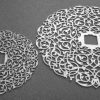
About laser cutting technology: nuances, features, characteristics
Laser cutting is the most efficient modern method of processing metals and steels. It makes it possible to create complex parts without damaging the surface of sheets made of titanium, copper, brass, stainless steel, aluminum, etc.
Lasers are used as part of various industrial equipment. It allows you to achieve high precision in cutting and sheet metal cutting, which is not possible with mechanical processing technology. Milling cutters, hacksaws and saws make the edge of the material uneven. Laser cutting significantly speeds up and simplifies the process of creating metal products, while at the same time simplifying the work of the part designer.
A focused laser beam allows you to cut a product at a very sharp angle. Laser cutting is a non-contact cutting method that allows these machines to work with very thin sheets.
The main advantage of this technology is that it eliminates the need for additional cutting tools, which have a limited life. The use of laser equipment speeds up the processing of parts, which means that the life of the machine is consumed more slowly. The second advantage is the exceptional accuracy of material cutting.
Currently, two types of laser equipment are used in the industry:
- Solid state. Characterized by low power (up to 6 kW) and small wavelength (1 micron).
- Gas. Very high power up to 15 thousand watts. Helium, argon, nitrogen and carbon dioxide are used to generate the laser beam.
Each type of laser can emit a pulsed or continuous beam.
Modern companies offering laser cutting services are able to perform their tasks with advanced equipment. Most modern laser systems are equipped with a display and a keyboard. The software is updated – the operator works with the menu in his native language. Many laser machines have automatic focusing, high quality capacitive sensors and machine vision technology.
Positive and negative aspects of laser cutting
This technology is valued for such things as:
- exceptional accuracy;
- the metal surface does not heat up;
- allows you to produce parts of complex shapes;
- ease of use of the equipment;
- high quality of cutting;
- the ability to create unique products;
- laser contact with metal does not deform the material;
- no mechanical impact on the material;
- cutting is carried out in a non-contact way;
- The technology can be used for materials with high thermal conductivity;
- complex and fragile products can be manufactured;
- the production process is automated;
- no dust is generated during cutting;
- You can cut wood, plastic, fabric, cardboard, and even leather;
- the ability to process materials with an increased risk of deformation;
- high speed of project implementation;
- small heat affected area.
Disadvantages of the cutting process:
- do not use thick metal;
- high cost of the service;
- cutting efficiency parameters depend on the characteristics of the equipment;
- there are limitations on the thickness of the material;
- no balling, extraction or louvering is allowed;
- production speed may decrease due to various factors;
- only metal sheet with dimensions of 1500×3000 mm can be processed;
- unprofessional use of the equipment leads to burning of the material.
- technological advantages of laser cutting:
- the created part has a perfect cut line;
- significantly reduced material consumption;
- You can perform complex contour cuts;
- You can cut small-diameter holes in thick metal;
- processing of thick metal sheets or products is simplified;
- you can create parts for unique projects.
Technological advantages of laser cutting:
- the created part has a perfect cut line;
- significantly reduced material consumption;
- You can perform complex contour cuts;
- You can cut small-diameter holes in thick metal;
- processing of thick metal sheets or products is simplified;
- you can create parts for unique projects.
The nuances of cutting certain types of metals, steels and alloys
Titanium cutting by laser
Pure titanium reacts well to the laser beam. When oxygen is used, the cutting speed increases significantly. However, an oxide layer forms along the cutting line, which can be quickly removed with an oxygen jet.
Cutting an aluminum sheet
Aluminum has an increased thermal conductivity and a high reflection coefficient depending on the wavelength. Cutting requires the use of a high-precision laser with a minimum power of 500 watts. The process uses a gas that removes molten metal near the cutting line. This significantly improves the quality of the cut metal – a band saw is not comparable.
Features of cutting copper and brass
This metal absorbs some of the energy. Otherwise, copper and brass react to the laser in the same way as aluminum.
Laser cutting of tool steel
Tool steel is similar to alloy steel in many ways. It is highly resistant to laser radiation.
Stainless steel under a laser beam
Laser cutting shows its advantages when it comes to cutting stainless steel parts. The use of this technology minimizes the heat affected zone, which allows the metal to retain its corrosion resistance. However, the processing speed of such metal is slower because there is no reaction of stainless steel with oxygen.
Cutting alloy steel
Most alloy steels are suitable for this type of processing. Alloys manufactured to AISI-SAE 4130 and 4340 standards are excellent for laser machining – cutting accuracy is very high and the cut surface is free of roughness.
Задайте питання або залиште коментар
і ми зв’яжемося з вами в найкоротші терміни
Пишіть, ми чекаємо