
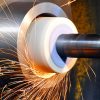
Processing of metal, steel, alloys
Metals and alloys have a wide range of applications. They are used to create equipment, tools, devices to perform a certain type of work, transport components, and so on. To transform a metal ingot into a full-fledged product, it is necessary to give it the necessary shape, parameters, chemical composition and physical properties. In the course of scientific and technical progress, many variants of metalworking were invented.
Long ago, mankind began to process metals with two goals: to obtain weapons and jewelry. Therefore, techniques have been practiced since ancient times, with the help of which it was possible to obtain blanks for barbed and cutting (knives, swords, arrowheads, spears) and artistic metal objects (jewelry, dishes). There are three types of artistic processing of metals: forging, casting and embossing. In the 20th century, welding entered this list. Each type of technology is performed with the help of certain equipment and tools. As a result, a beautiful product is created or a created one is decorated.
The oldest technology is casting. The metal is melted and poured into a special form to create the future product or part. Thanks to this method, you can get durable castings with different properties. Carving is a method of creating a certain relief on the surface of a metal. Also applies to heated metal.
We will talk about forging below.
Types and types of metalworking
All options for processing metals and steels can be divided into several types: mechanical cutting, casting and welding. Also, the workpiece is subject to thermal, electrical and chemical treatment.
Welding
Welding metals is an old and efficient method. It began to be used about 100 years ago. This process consists in combining two metal components, a certain area of which is brought to a molten state with the help of a welding machine. After cooling, the parts are securely attached to each other.
There are several types of welding technology:
Chemical. The metal is heated in the form of a chemical reaction. This technology is otherwise called termite technology. It is used to connect parts in hard-to-reach places where it is not possible to use other methods. A chemical reaction can occur under water.
Gas A specific area is heated using a special gas-powered device. When using a special nozzle, you can weld or cut a metal workpiece.
Electric welding. There are two popular methods:
- arched. It is used for heating or melting. Welding devices are used to maintain a high temperature. Welding is carried out using special components in an inert gas;
- contact welding is performed by contacting the metal workpiece with electricity. There is spot welding, when the components touch a certain area, and roller welding, when a roller rolls on the surface of the workpieces and connects them with a continuous seam.
Welding is used to create complex structures used as part of mechanisms, buildings, pipelines, ground and guided transport.
Electric metalworking
Electrotreatment of steels works by partially changing the structure with the help of electricity. Due to intense impact, holes appear on the surface of a thin metal sheet. This method is also used to work with hard alloys. Thanks to electrical processing, parts of a broken part can be pulled out of a narrow opening and repairs can be made without disassembling or destroying the device.
The basis of the device is an electrode made of graphite or brass, which is connected to a source of electricity. A spark is cut and the metal surface melts and splits. A special oily substance is used to stop flying metal drops. This technology is implemented using ultrasonic exposure. For this, the metal is exposed to high frequency. Resonance leads to point destruction of the upper layer. This technology is suitable for strong alloys, stainless steel and valuable products.
Methods of mechanical metalworking
Mechanical processing of metal includes a large set of technologies. Each method has a certain feature – a sharp and hard part is used to affect the surface, which changes the shape of the workpiece. As a result of mechanical action, the metal layer is removed. The amount of metal that has been removed in the machining process is called the allowance.
Variants of mechanical metalworking:
Turning The metal workpiece is fixed inside the rotating tool, to which the cutter is fed. It removes a certain amount of metal to give the workpiece a certain shape. This method is used to manufacture components of various equipment that have a specific form of rotation.
Drilling. A rotating drill is plunged into the workpiece. The hole has a round cross-section.
Milling. A special drill with a unique side surface is used for processing. The milling cutter changes its position, which allows to increase or decrease the effect on the metal.
Planing. The cutter moves across the surface of the part, removing a certain amount of metal. In some equipment, the cutter is stationary. It is used to create longitudinal grooves.
Grinding. For processing, rotation or movement in a certain direction is performed to remove a layer of metal of a specific thickness. It is used to treat surfaces before applying a protective or decorative coating.
Each type of impact on a steel billet requires the presence of certain equipment. Often, to create a certain part, it is necessary to subject the workpiece to several types of processing. This is done to increase the service life of the finished product and, accordingly, optimize performance and reduce replacement costs.
Pressure treatment. Pressure treatment of metals and alloys is used to change the shape of a steel billet without changing its integrity. There are two types of impact: stamping and forging. Before forging, the future product is heated. It is installed on a strong base and one of the ends of the product is struck with a heavy object to give it a certain shape.
Previously, this pressure treatment of metals was used by a blacksmith who heated the metal in a furnace, removed it with tongs and used a hammer to change the shape. The result was a cold weapon or a tool. In modern conditions, instead of a hammer, a press is used, which exerts a pressure of several thousand tons. Metal products several tens of meters long are heated to a high temperature and undergo a change in shape.
Ready stamps can also be used. For stamping, it is necessary to take two forms that have the same parameters. The metal product is contained between these parts, which slide together under great pressure. The workpiece is bent and the finished product is formed. To bend stronger workpieces, the metal is heated to achieve a certain degree of plasticity. This technology is called hot stamping. Bending and other forms of deformation may occur during stamping. With the help of this technology, it is possible to create products of almost any shape – from the simplest components of mechanisms to full-fledged tools.
Processing by means of cutting Cutting is necessary to accurately remove excess. The metal is supplied as rolled steel with certain parameters. To create blanks of a specific size, it is necessary to cut a sheet. For metal rolling, a device with an abrasive wheel or a disc-type saw is used.
Cutting of metals is carried out in the following ways: Manual. A device for gas welding is used, with the help of which parts of metal of a specific size are torn out. The technology is used by employees of small organizations.
- Gaseous. Automatic gas cutting is used, which allows you to quickly cut and sort the products for further transportation.
- Laser. Cutting is carried out using a laser beam. The technology is implemented when high cutting accuracy is required. With the help of a laser, you can perform welding and engraving.
- Plasma. Cutting is carried out using a torch powered by a special gas. A plasma is produced, which cuts the rolled metal from a hard and unique alloy.
- It is important to take into account the coefficient of the used metal, which is reduced due to the use of cutting.
Chemical influence
Chemical processing of metal is carried out using the action of a substance or substance. It not only performs processing, but also cleans the surface for welding or painting. Chemical treatment of metals makes it possible to protect the metal from rusting and create a protective layer.
Types of temperature (thermal) treatment This technology is used to improve physical and mechanical properties. The following methods are distinguished:
- Annealing. The metal is heated to a flexible state. This allows to reduce the hardness of steel.
- Hardening The workpiece is heated to increase flexibility and held in this condition to stabilize the structure. Due to this, the strength increases.
- Vacation. It is done after completion of hardening. The temperature of the metal increases to a level that is less than the necessary indicator for tempering, and it cools. Fragility is reduced.
- Aging. Provides an opportunity to stimulate the processes that occur due to the aging of the workpiece.
- Normalization. An increase in ductility is carried out.
To order metal processing in Dnipro, contact PE “TD TAM”
You can order the following services from us:
- Heat treatment of metals (hardening, annealing, cementation, normalization, nitriding).
- Gas cutting of metals.
- Plasma cutting.
- Turning and milling works.
- Drilling and coordinate boring works.
Contact the phone numbers indicated on the website or via the feedback form.
Задайте питання або залиште коментар
і ми зв’яжемося з вами в найкоротші терміни
Пишіть, ми чекаємо