
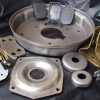
Cold stamping: process features, material
Stamping of steel sheet products is a widely used metalworking technology for the production of mechanical and structural parts. The process involves creating special conditions when the workpiece is subjected to mechanical stress, which causes deformation according to specified parameters.
This type of metalworking makes it possible to produce small and large components of mechanisms for equipment or vehicles. The shape can be simple or very complex. The blank is a sheet of steel or a metal product of another shape or a derived product. There are two main stamping methods: hot stamping and cold stamping.
In this article, we will focus on cold technology.
Cold stamping: technology features
If the workpiece is heated during the hot stamping process, no heating is required. Cold forming is used for thin steel sheets, soft metals, alloys or polymeric materials. This technology is used to produce agricultural vehicle components, fasteners and high-precision products, and is characterized by excellent productivity.
Cold stamping makes it possible to produce products with precise parameters and without surface defects (surface quality corresponds to class 8).
What technological actions can be performed in the process of applying this technology:
- Cutout. Allows you to create round parts or products with a closed shape. The punching is performed on a prepared line.
- Punching. Used to produce high quality, precise holes.
- Drawing. It is used to form a workpiece of a certain shape. The sheet is stretched according to the customer’s requirements.
- Creating sides. Most often, this action is used to create pipe sides.
- Crimping. Allows you to narrow the ends of hollow parts.
- Bend. Allows you to bend the part at an angle.
- Molding. As a result of this action, the product takes the required shape in a specific area.
What types of steel are subject to cold forming?
This technology uses low carbon steel containing 0.2% Cr, 0.4% manganese and minimal amounts of nitrogen, O2 and H. The most popular grade is 08 kp/sp/ps.
Carbon steels are also suitable for this technology.
Low-alloy steel grades 03hgju, 06hgju, 12hm and 06g2ju are used to produce products with high precision parameters. Manganese, chromium, silicon, tungsten and aluminum are added for alloying.
A special press with a punch is used to perform the technology. The parts are processed using a punch and a die, which can be made of various materials (including wood). Hydraulic presses of various technical characteristics are most often used.
Задайте питання або залиште коментар
і ми зв’яжемося з вами в найкоротші терміни
Пишіть, ми чекаємо