
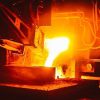
Elements for alloying metals and the properties they add to alloys
The finished steel product is marked according to the presence of alloying components that were added during the production process. It is important for the manufacturer and the buyer to know the properties of additives used at modern enterprises in the process of creating steel alloys and, accordingly, final steel blanks. Let’s consider the main additional elements that affect the physical and chemical characteristics of a steel alloy product.
Chromium
This component is used to provide corrosion resistance qualities. It increases strength and hardness indicators. This additive is used to create stainless steel.
Nickel
The addition of this element increases flexibility, viscosity and corrosion resistance.
Titanium
Aimed at reducing grain size, increasing strength and density. Use to facilitate workability and resistance to rust formation.
Vanadium
Grain reduction is also applied. The fluidity increases and the tensile strength of the steel billet decreases.
Molybdenum
After adding this component, calcination is improved, brittleness is reduced, and resistance to rusting is improved.
Tungsten
This element is designed to increase hardness. It prevents steel components from changing size and reduces brittleness.
Silicon
If you add from 1 to 15% of this component, the workpiece will become stronger, but will retain viscosity. The percentage content of silicon increases electrical resistance and magnetic permeability. Silicon is added to improve elasticity, rust resistance and oxidation resistance. However, the component makes the workpiece more fragile.
Cobalt
This component is added to improve resistance to shock and excessive heat.
Aluminum
The use of this element helps to increase scale resistance.
Carbon
This is one of the most popular elements that greatly changes the properties of steel. If you add up to 1.2% of this component, the final product will become stronger, harder, and the yield point will increase. However, if more than 1.2% carbon is added, flexibility and fluidity are significantly reduced.
Manganese
If the percentage of manganese content is slightly more than 0.8%, it belongs to the impurity category. Its task is to increase the deoxidation index and increase resistance to the destructive effect of sulfur on steel products.
Sulfur
If the sulfur content exceeds 0.65%, the mechanical properties of the steel billet are significantly reduced. It becomes less plastic, loses resistance to corrosion and impact strength. Sulfur in large quantities did not begin to boil.
Phosphorus
If the phosphorus content is even slightly exceeded, the steel immediately becomes brittle and fluid. The index of plasticity and viscosity also decreases.
Nitrogen and oxygen
If the content of these elements is exceeded, the finished product becomes brittle, less viscous and plastic.
Hydrogen
Exceeding the normal content of this component significantly increases the fragility of the product.
It is important to be aware of the impact of negative impurities on the properties of the final steel product. Any steel alloy contains a certain process of impurities in its composition, and it is quite difficult to remove them from the alloy. The category of impurities includes carbon, sulfur, manganese, silicon, phosphorus, nitrogen and oxygen.
For the purchase of boron-containing alloy steels, tool and structural alloy steels in Dnipro, contact the supplier of rolled metal PP “TD TAM”.
Задайте питання або залиште коментар
і ми зв’яжемося з вами в найкоротші терміни
Пишіть, ми чекаємо